Vietnam from North to South: 3 Unforgettable Weeks
Vietnam is a country that overwhelms you in the best way. The orderly chaos of Hanoi, the serenity of Ha Long, the endless rice fields of Sapa, the imperial ruins of Hue, the energy of Ho Chi Minh... This is our journey from north to south through one of Southeast Asia's most fascinating countries.
Hanoi: Charming chaos
Hanoi hits all your senses at once. Millions of motorbikes in an impossible ballet, street vendors with their characteristic conical hats, the aroma of phở coming from every corner. It's chaotic, noisy, intense... and absolutely addictive.
The Old Quarter is a maze of 36 streets, each traditionally dedicated to a craft. Silk Street, Paper Street, Bamboo Street... We spent hours getting lost, stopping at cafes where egg coffee (cà phê trứng) is served in cups over a bain-marie of hot water.
Ho Chi Minh's Mausoleum and the Temple of Literature are must-visits. But the best of Hanoi is in its details: the elderly practicing tai chi at dawn by Hoan Kiem Lake, the perfect banh mi carts for €1, the street breweries where 'bia hoi' costs 20 cents a glass.
Ha Long Bay: Among mountains of water
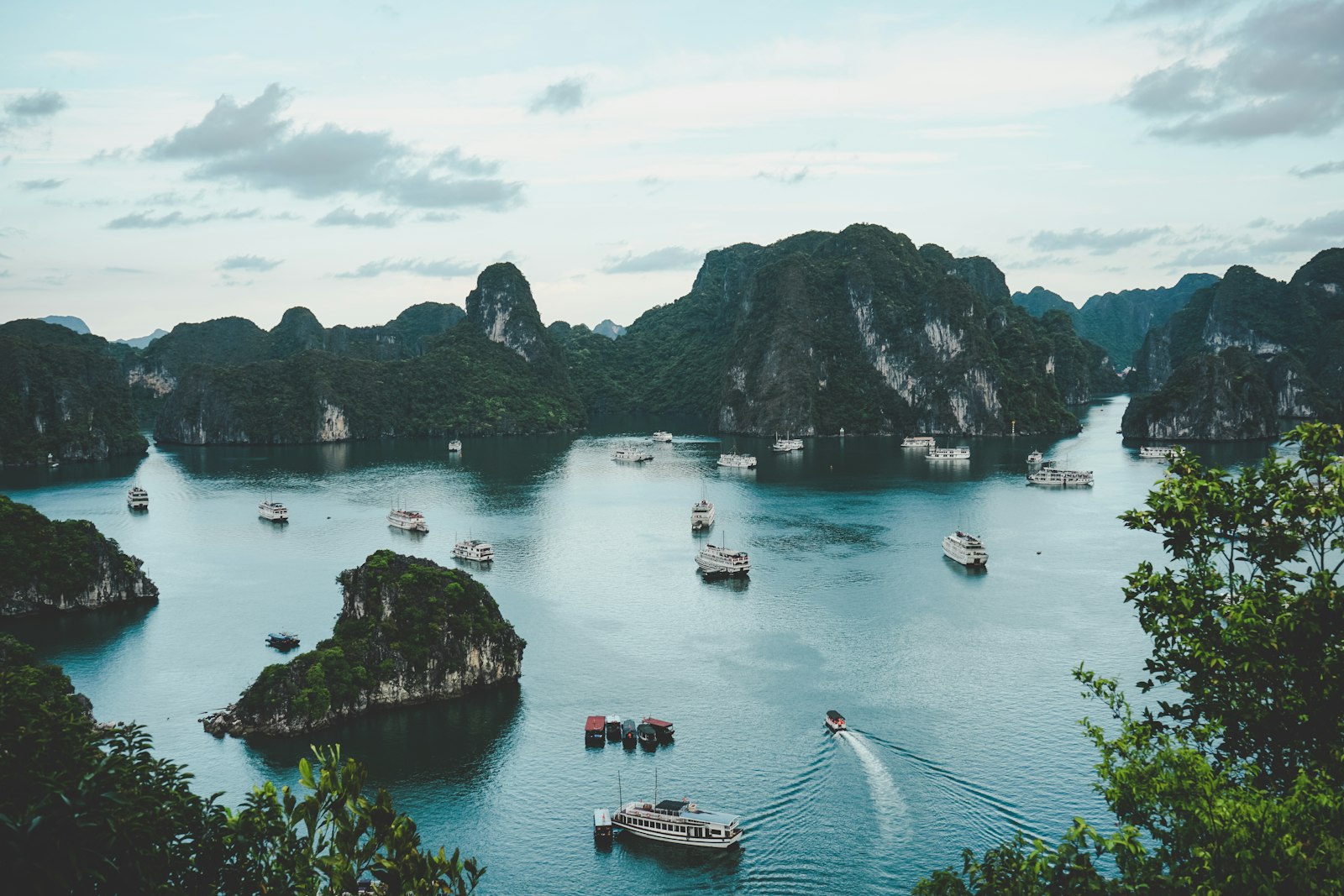
Ha Long Bay seems taken from a legend. More than 1,600 limestone islands emerging from emerald waters, forming a labyrinth of bays, caves, and hidden beaches. It's a World Heritage Site and you understand why as soon as you arrive.
We booked a 2-day/1-night cruise (€150 per person, all-inclusive). We sailed among the rock formations while the sun played with the morning mist. In the afternoon, kayaking among islands, exploring caves and deserted beaches accessible only by water.
The night on the boat, anchored in the middle of the bay, we dined on fresh seafood while stars appeared over the karst mountains. At 5 AM, tai chi classes on deck with sunrise painting everything pink.
Tip: avoid cheap mass cruises. Invest a bit more in boutique boats with small groups.
Sapa: Rice terraces and remote ethnicities
The overnight train from Hanoi to Lao Cai (€30 in private cabin) is an experience in itself. You wake up with the mountains of northern Vietnam peeking through the window. An hour by taxi and you arrive in Sapa.
Sapa's rice terraces are the most impressive agricultural landscape we've seen. Green stairs sculpted into the mountains by generations of the Hmong ethnic group. We hired a local Hmong guide (€15/day) who took us along trails to villages where life continues as it has for centuries.
We slept in a homestay in Ta Van, a wooden house on stilts with infinite views of the rice fields. The family cooked us a traditional dinner and taught us Hmong words while their children played among chickens and buffalo.
The trek to Fansipan, the roof of Indochina (3,143 m), can be done in one day with a cable car or in 2 days on foot for adventurers.
Hue and Hoi An: History and charm
Hue was the imperial capital of Vietnam and preserves a forbidden citadel that rivals Beijing's. The tombs of the Nguyen emperors, scattered across the surrounding hills, are elaborate mausoleums blending Vietnamese, Chinese, and French architecture.
The best way to explore Hue is by motorbike (€5/day). We toured the Imperial Citadel, sailed the Perfume River to Thien Mu Pagoda, and ate bun bo Hue (the local spicy soup) at street markets.
Hoi An is the perfect counterpoint. This ancient trading town is perfectly preserved: silk lanterns lighting up the nights, tailors making custom suits in 24 hours, 17th-century Japanese bridges. At night, locals release floating lanterns on the Thu Bon River.
My Son Sanctuary, 4th-century Cham ruins, is an hour away and transports you to another world: Hindu temples in the middle of the jungle, the civilization that dominated Vietnam before the Vietnamese.
Ho Chi Minh City: Modern Vietnam
Saigon (no local calls it Ho Chi Minh City) is Vietnam's future. Skyscrapers next to pagodas, rooftop bars with infinite views, restaurants fusing tradition with avant-garde.
District 1 has the French colonial architecture: Notre-Dame Cathedral, the Post Office building designed by Eiffel, the Opera. But the real Saigon is in the markets: Ben Thanh for souvenirs, Binh Tay in Cholon (Chinatown) to see local life unfiltered.
The Cu Chi Tunnels, an hour from the city, are a sobering reminder of the war: 200 km of underground tunnels where the Viet Cong lived and fought. You can crawl through some sections (claustrophobic but fascinating).
To finish, we dined at Cục Gạch Quán: traditional Vietnamese cuisine in a restored colonial house, with a tasting menu for €25. The perfect ending to three weeks of unforgettable flavors.
Tips for traveling through Vietnam
- 1Carry cash: many places only accept Vietnamese dong. ATMs dispense maximum 2-3 million VND (€80-120).
- 2Download Grab (the Asian Uber): works for motorbikes, cars, and food delivery.
- 3The overnight train is the best way to cover long distances: you save a hotel night and see the landscape.
- 4Always negotiate at markets (up to 50% off initial price) but not at restaurants or fixed transport.
- 5Get vaccinated for hepatitis A and typhoid, and bring strong mosquito repellent.
Approximate budget (per person, 3 weeks)
- Flights Madrid-Hanoi-Ho Chi Minh-Madrid€550
- Internal transport (trains, buses, flights)€150
- Accommodation (hotels and homestays)€300
- Food and drinks€200
- Activities and tours€200
- Approximate total€1,400
Plan this trip
Itineraries, budgets and real traveler routes for this destination.
More stories from Vietnam
Ready for your Vietnamese adventure? Download Odysseus and plan every stage of your trip.
Create a free account on the web